“Be careful lads, it’s about 60 miles an hour winds on the top”.
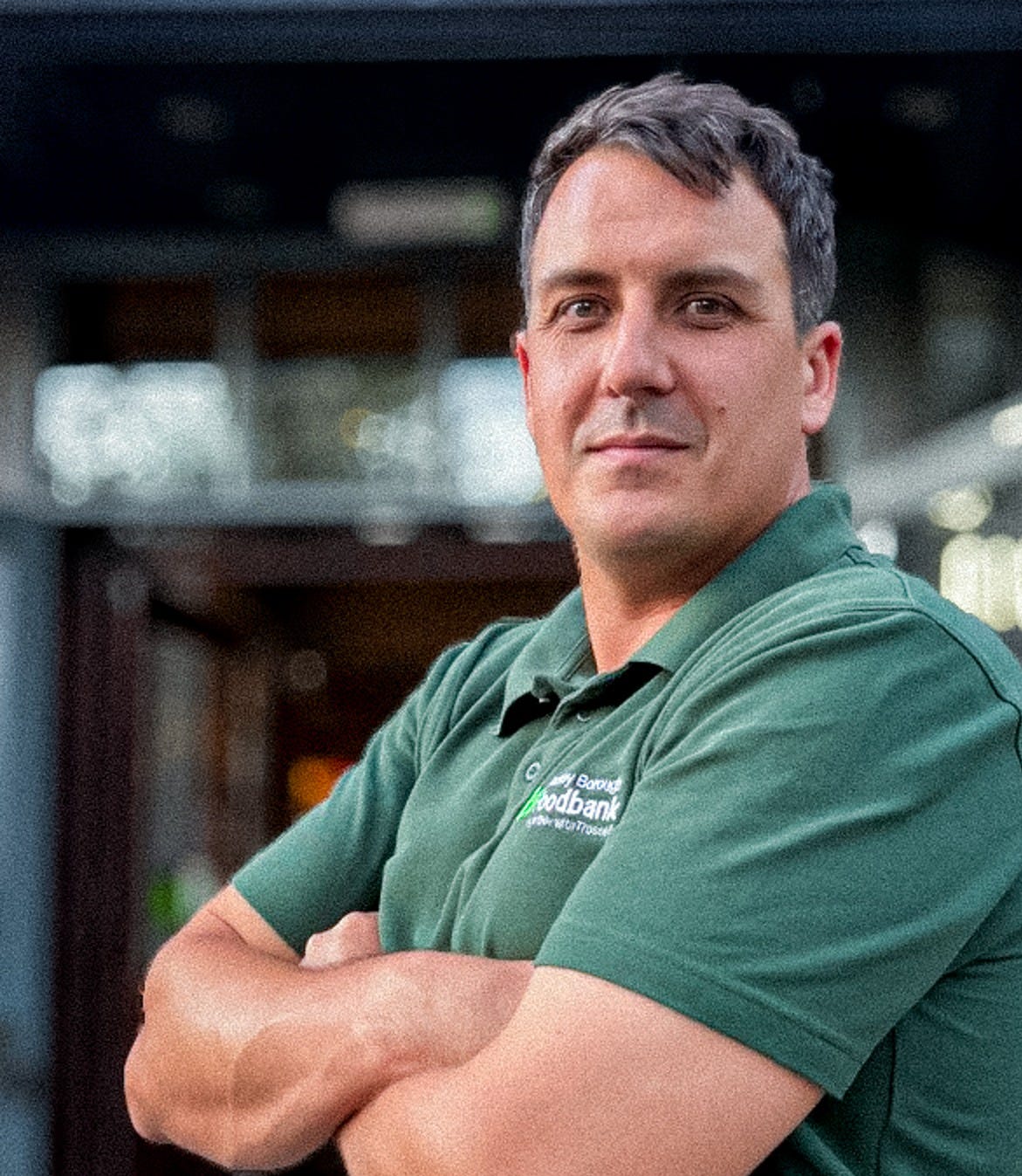
This was a warning given to Iraq veteran and former ambulance worker Danny Insall by a descending climber as he began his climb up Mount Snowdon at 1 a.m. on Sunday, 6 June 2026. Drenched to the bone and plodding upwards on limbs that had long felt betrayed by their owner, these were not the words he wanted to hear on their final climb of the day, particularly when time was running out.
Alongside him, though it would be hard to see them in the dark, were his closest military friends, Aaron (known affectionately by his surname, Lucas) and Adam. Danny had met them twenty-four years previously, at the age of 18 when he first completed basic training in the British armed forces. The band of brothers had crossed the globe together, felt the heat of the sun and IEDs in Iraq, and now were summiting one last peak as part of their Three Peaks Challenge in aid of a local charity.
Reaching the top, and having raised significantly over their target for Bromley Foodbank there was no time to take in the non-existent view. In order to complete the challenge, which takes you up and over the UK’s three largest mountains: Ben Nevis, Scarfell pike and Snowdon, in that order, you must complete it in 24 hours. Time was running out on Danny and his friends.
“I’ve been closer to the wire before,” Danny laughs over a well-deserved pint at the Queen’s Head. “But this was a different kind of pain. After the second mountain my legs were gone, the weather was horrific, and the boys were winding me up the whole way. But we had to press on”
From Sydenham to Baghdad
To understand what drives Danny Ansel to push his body to the limit, you have to go back to where it all began. Raised on the Sydenham estate, Danny admits he was heading down a dangerous path as a teenager. “My dad sat me down when I was 16,” Danny recalls candidly over a pint of Estrella. “He looked me dead in the eye and said, ‘You’ve got two options: prison or the army.’ The next day he marched me down to the recruitment office. I thank him every single day for that.”
“You’ve got two options: prison or the army.”
Danny entered the Army Foundation College for a year of intense phase-one training, correcting his GCSEs in the process, before heading to the infantry training centre at Catterick. It was a baptism of fire including drills, trenches, tactics, and live-fire simulations.
Upon passing out, Danny was posted to the 2nd Battalion of the Princess of Wales’s Royal Regiment (PWRR). It was there, in the tight confines of a four-man barrack room, that a lifelong brotherhood was forged. Danny was placed in B Company, 6 Platoon, alongside Adam. Meanwhile, Lucas was posted to A Company.
“From day one, we had that connection,” Danny says. “Lucas and I bonded instantly because we followed the same football team: Millwall. Week in, week out, we were obsessed. We got to know Lucas on our first tour”
The Great FA Cup Escape
That obsession with Millwall Football Club would eventually lead to one of the most legendary and high-stakes gambles of Danny’s military career.
In May 2004, Danny’s company was due to be deployed on a months-long military exercise in Canada. At the same time, Millwall had defied all odds to reach the FA Cup Final against Manchester United. “My dad rang me up on the day of the final,” Danny grins. “He said, ‘I’ve got a spare ticket for you.’ I told him, ‘Dad, you know I can’t go, I’m off to Canada tomorrow.’ He replied, ‘Danny, you will never see Millwall in an FA Cup Final again in your lifetime.’ That was it. Decision made!”
Danny packed his bergen, left his webbing neatly on the end of his army bed, and slipped away from the base, leaving a brief note for his sergeant stating “Gone to see Millwall in the FA final”.
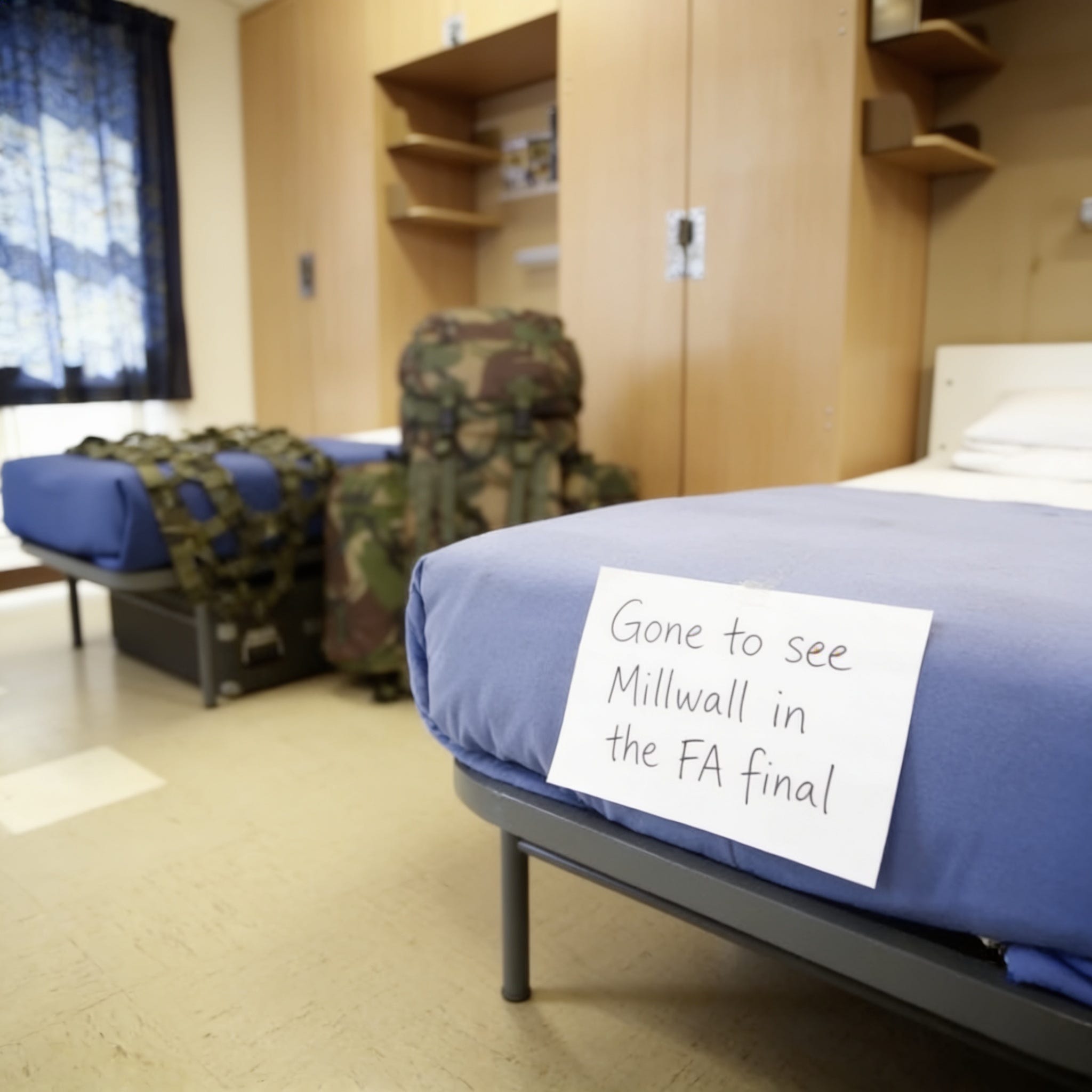
The same father who marched him into the army was waiting outside the gates in a getaway vehicle.
After watching his beloved Lions at the Millennium Stadium in Cardiff, Danny spent a couple of days enjoying family life before returning to face the music. Only the music never came.
Travelling back to his UK barracks on a Tuesday, he discovered the entire battalion had already flown out to Canada. Only a skeleton rear-party remained.
“I sort of lied to the Provost Sergeant,” Danny admits. “I told him I’d been on authorised leave. They didn’t have a clue, so they just put me on a flight out to Canada to rejoin my unit. I thought I’d completely got away with it.”
He hadn’t. When he landed in Canada, his Sergeant, Lee Callow, met him with a grim look on his face. Danny was marched into the office of the Regimental Sergeant Major (RSM)- the most feared man in the battalion.
“He told the corporals to leave the room and shut the door,” Danny says, lowering his voice. “He got up, checked the windows, made sure no one was listening, sat back down, and told me to take a seat. Then he looked at me and said, ‘You are incredibly lucky that I’m a Millwall fan. Otherwise, you’d be sitting in Colchester Military Prison right now.’”
‘You are incredibly lucky that I’m a Millwall fan. Otherwise, you’d be sitting in Colchester Military Prison right now.’”
Instead of prison, he was issued a peeler. “He told me I had to punish myself. My penalty? I had to hand-peel exactly 874 potatoes for the cookhouse. My thumbs were absolutely raw by the end of it, but it was worth every single spud to see that final.”
The Bonds of War
The lighthearted camaraderie of football and barrack room pranks was balanced by the sobering, heavy realities of active service. Danny, Adam, and Lucas were deployed together to Northern Ireland in the early 2000s during the tense, fragile post-Troubles era.
“The Rules of Engagement were drilled into your head,” Danny explains. “You had a yellow card. If someone shot at you, you could shoot back. But if they turned their back to run away and you shot them, you’d commit a crime. On one occasion we had to attend an Orange march in full riot gear. We stood in the July heat wearing helmets and fireproof trousers for 10 hours. It was psychological endurance.”
From Northern Ireland, the battalion moved to Iraq, completing two separate, intense tours. In the heat and sand of Iraq “Me and Adam were using the buddy system constantly under contact,” Danny says quietly. “Checking his pouches, making sure his ammunition was tight, keeping each other moving. When you go through that, you never lose the connection. Even when I left the army years before Lucas did, he would ring me every single week from his tours in Afghanistan just to check-in. We’ve always had each other’s backs, whether it’s an argument in a local pub or a fire fight in Basra.”
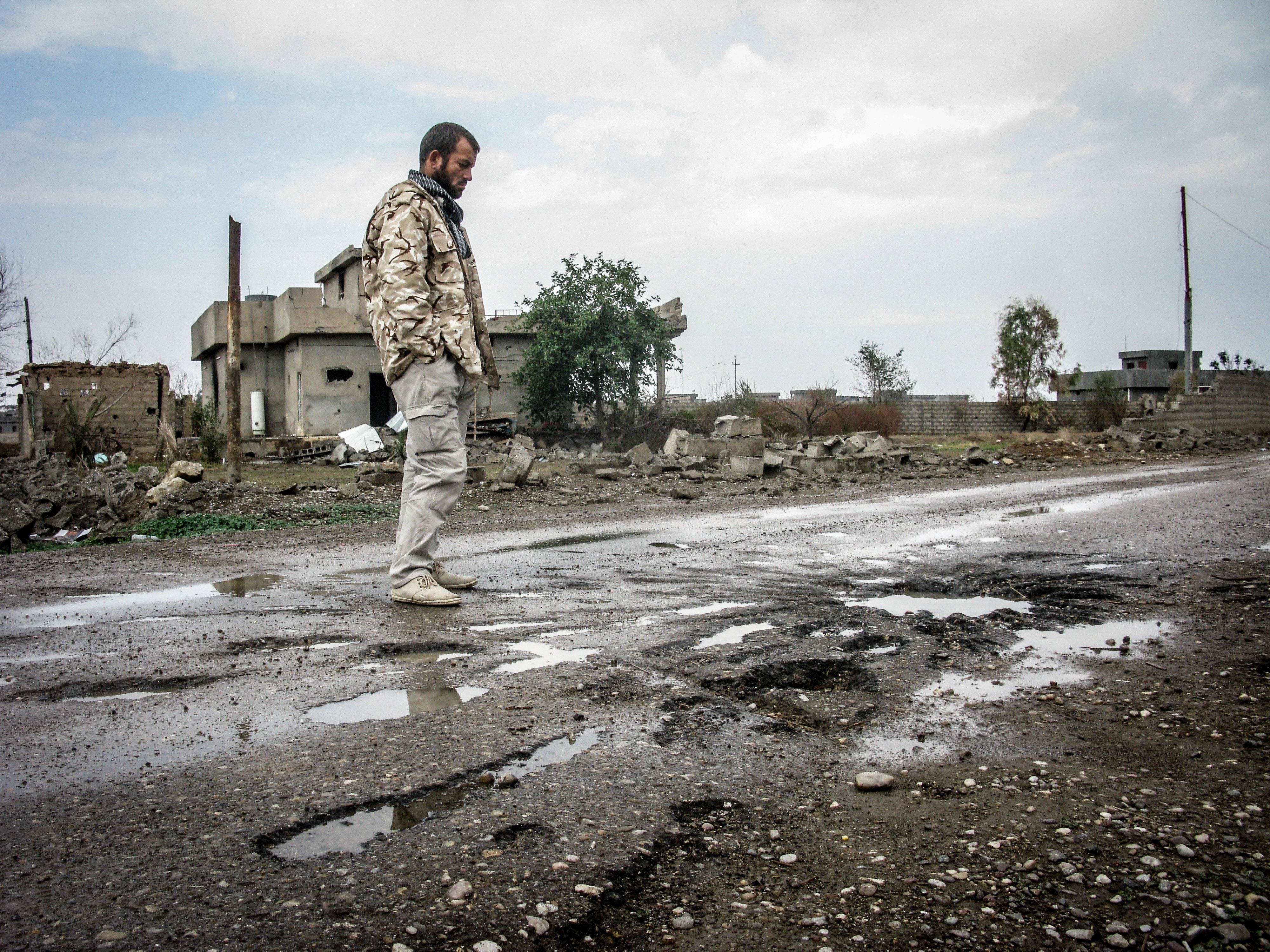
The transition back to civilian life wasn’t seamless. Danny went on to work for the ambulance service and now works for a local pest control business. He conceals it well, but one assumes he is carrying mental scars.
“Fireworks Night is always tough,” Danny confesses. “The sudden banging noises still get to me. And the military gives you a permanent sense of OCD and rigid organisation. My wife hates it because if we set a time to meet, my body physically forces me to be there 15 minutes early. I can’t help it.”
“Mental health can often be brushed under the carpet,” he informs me, “but it’s real.” Danny vividly recalls the devastating moment during their deployment when a fellow South African soldier in their battalion tragically took his own life in a utility room after receiving a breakup letter from home. “You could see a black figure swaying through the opaque window. It was the first time I’d ever seen suicide close-up. It stays with you.”
Feeding the Hungry of Bromley
Fast forward to January 2026. Danny’s wife, Jenny, who works tirelessly for the Bromley Borough Food Bank, mentioned how desperately difficult it had become to secure the funds necessary to feed local families in crisis.
“She asked me if I had any ideas to raise money,” Danny says. “I called up Lucas and Adam, and Adam immediately suggested the Three Peaks. They’re fitness fanatics. Adam runs marathons. Lucas does half.”
“What about you?” I enquired.
He paused, a momentary wave of insecurity passing over him before saying, “It took me a bit longer to get my fitness back.”
Danny’s training regime involved gruelling weekend runs, including a massive 22-mile foot-journey from his house straight to London Bridge and back, pounding the pavement along the A20 and Old Kent Road.
“Why did you do it?” I pressed.
“To think in our day and age there are kids that can’t afford milk or cereal. I’d climb those mountains ten times over to give ‘em a fridge full of food”
“When I was at school, I remember a boy named Kevin,” Danny recalls. “He used to steal other kids’ packed lunches because his parents literally couldn’t afford to feed him. That’s another memory that has stayed locked in my mind.”
“To think in our day and age there are kids that can’t afford milk or cereal. I’d climb those mountains ten times over to give ‘em a fridge full of food.” Danny, who at this point is beginning to imbibe Marcus Rashford vibes, smiles, taking a sip of his beer. “No child deserves to be without food.”
Hitting a wall on the Three Peaks
On 6 June, the challenge officially kicked off at 6:00 a.m. at the base of Ben Nevis in the Scottish Highlands. Driven by pure adrenaline, the team flew up the mountain. Adam, living up to his fitness fanatic reputation, summited the mountain in an astonishing one hour and 14 minutes by himself, waiting in the freezing snow at the top for Danny and Lucas to catch up. They completed Ben Nevis in a rapid 4 hours and 35 minutes, making time for some sledging and a snowball fight.
“We went up and down Ben Nevis far too quickly,” Danny admits in hindsight. “We used up way too much energy, and we didn’t rest or eat properly in the camper van on the drive down to England.”
By the time they reached Scafell Pike in the Lake District at dusk, the lack of recovery caught up with Danny. He hit the point of extreme muscle fatigue, also known as “hitting the wall”.
“Scafell Pike absolutely destroyed me. It’s steeper, and I was completely spent. I felt terrible because I knew I was holding the boys back. Every time I asked how far to the top, Lucas would say ‘20 minutes.’ Then 20 minutes would pass, I’d ask again, and he’d say ‘20 minutes!’ It wound me up entirely, but it kept me moving.”
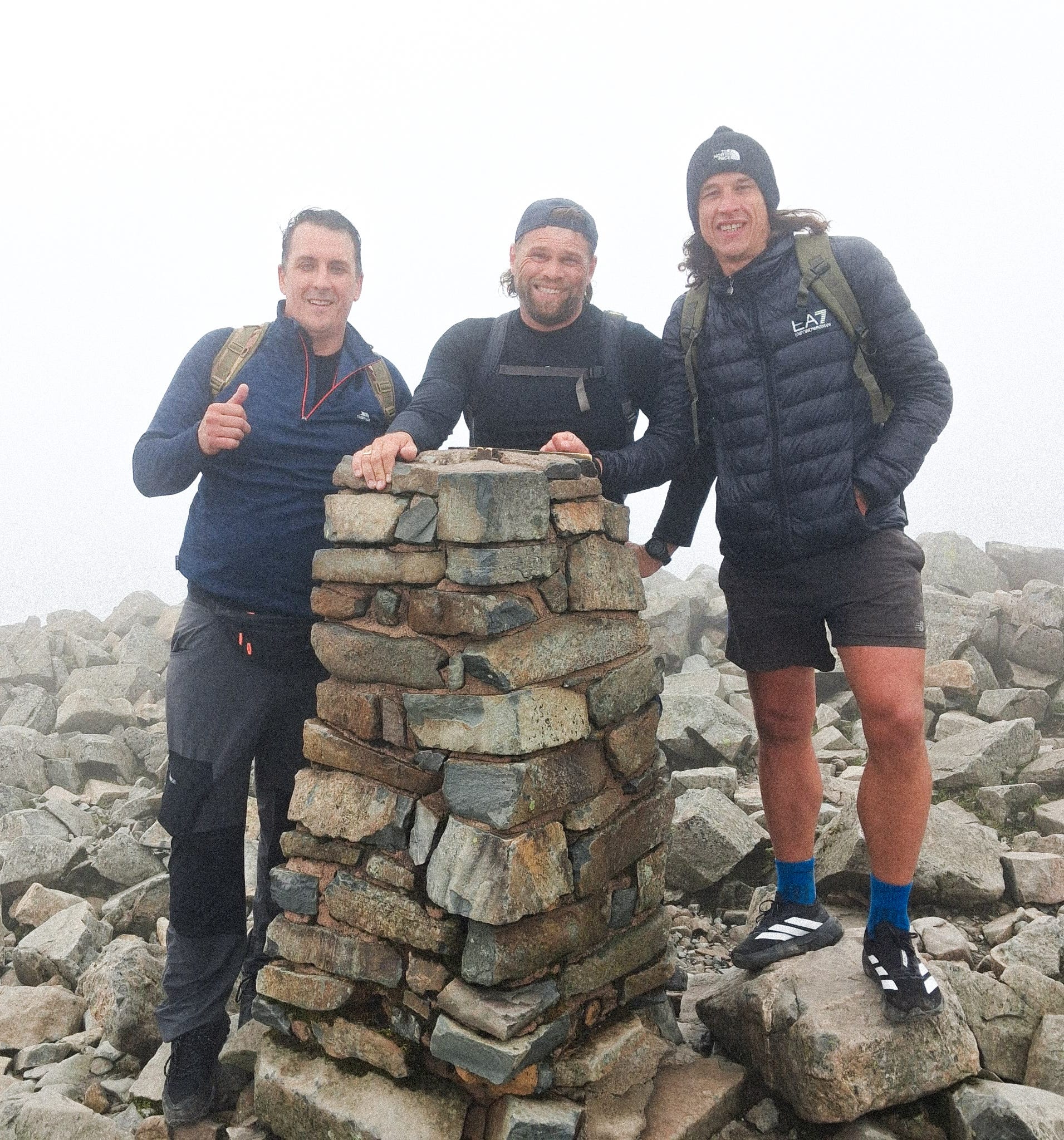
They cleared Scafell Pike in 3 hours and 42 minutes, scrambling back into the camper van to make the mad midnight dash to North Wales.
Snowdon welcomed them at 1:30 a.m. not with an ovation but with precipitation instead. Thick rain, pitch-black darkness, and howling 60 mph winds tore across the ridges. Halfway up the mountain, they encountered two hikers who had become entirely separated from a group of 15. Utilising their military navigation skills and relying on Adam’s Garmin watch, the three veterans took charge, guiding the stranded civilian hikers safely up the mountain paths to the summit shelter and the rest of their party.
“It was bonkers up there,” Danny laughs. “It was freezing, wet, and busy, yet as the sun started breaking through the clouds we even saw someone trying to walk up the mountain with a tiny Chihuahua dog!”
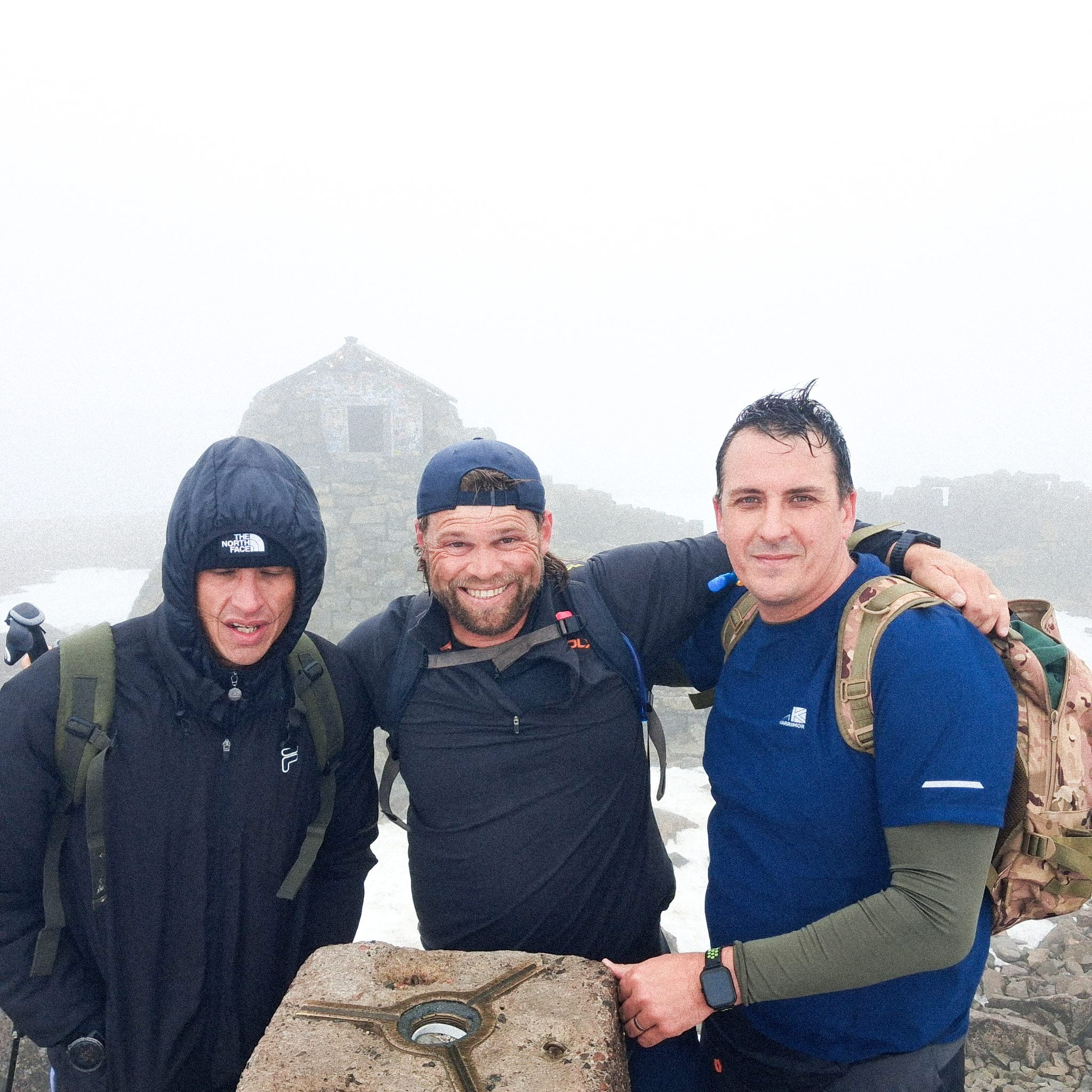
As ever, there was little time to take in the view. Hurtling down the mountain, they made it by a whisker. Stopping the clock at the infamous Pen-y-Pass car park gate, their final time was 23 hours and 46 minutes, a mere 14 minutes from the cut-off. Drying off by the van and checking their phones for the first time in a few hours, they realised they smashed their initial fundraising target of £1,500, raising an incredible £2,885 for the food bank. A double victory.
Yet in a country where 27% of males are alleged to have no close friends, one wonders whether the true victory wasn’t measured in minutes or pounds, but in a friendship strong enough to endure the whizz of bullets, the passage of years, and the sweat of a meaningful challenge.
“What are you thinking of doing next?” I enquire.
“Well, I’ve secured a place in the London Marathon in 2027”, Danny says unconvincingly.
“We might do the Yorkshire Three Peaks with a twist”, he says with a little more gusto.
“Mount Kilimanjaro’s also on the table.”
“Now we’re talking!” I replied.
Whatever you do, keep the Chislehurst Observer posted.
If you enjoyed this article considering supporting their fundraising appeal. Click here
_____________________________________________________
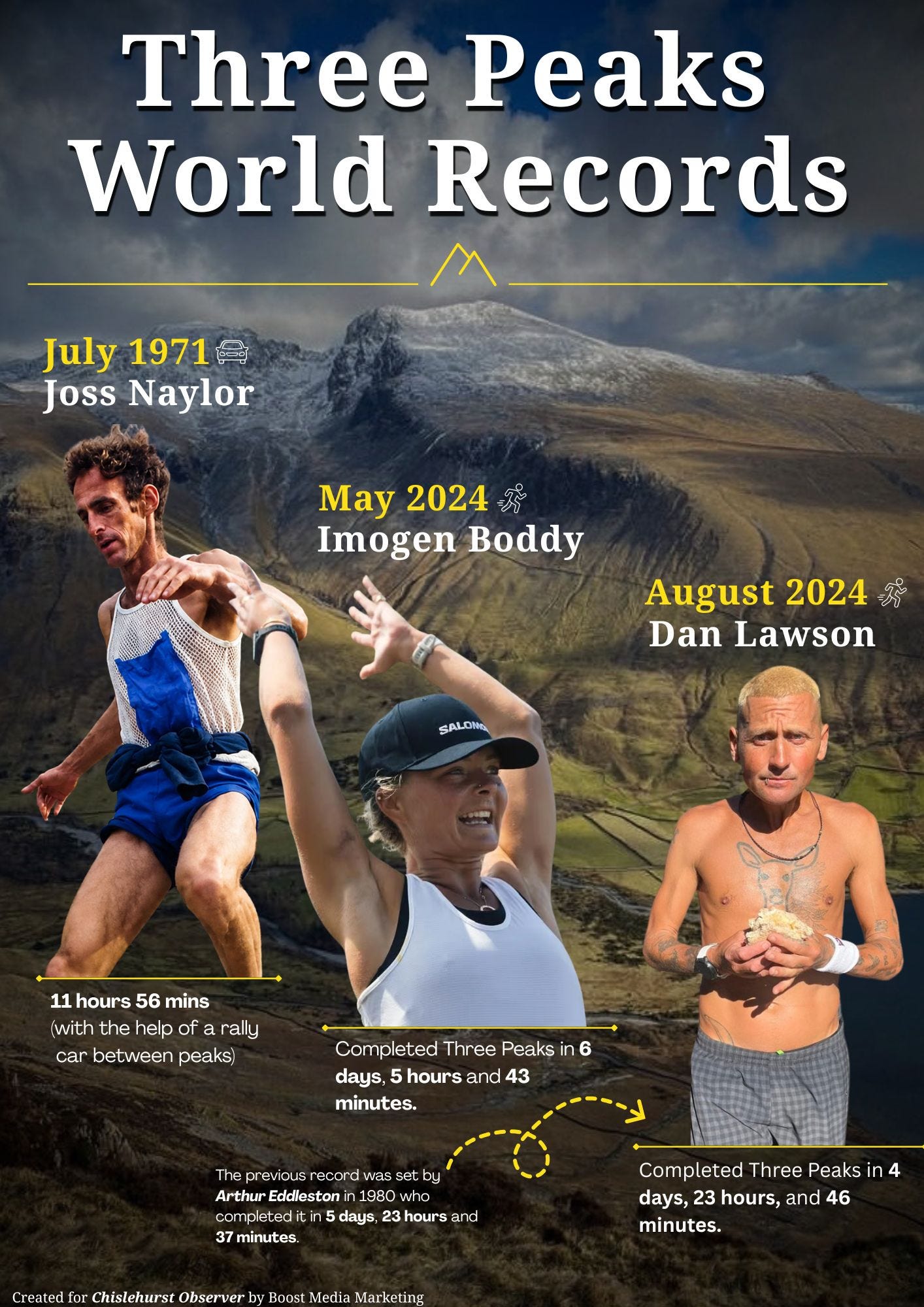
If your interested the world record for the UK three peaks was set in 1971 by Joss Naylor, who, with the help of a rally car driver completed it in half the time Danny and the boys did. Records for running between the peaks resisted conquest for four decades until last summer when two ultra athletes smashed them in both female and male categories.