


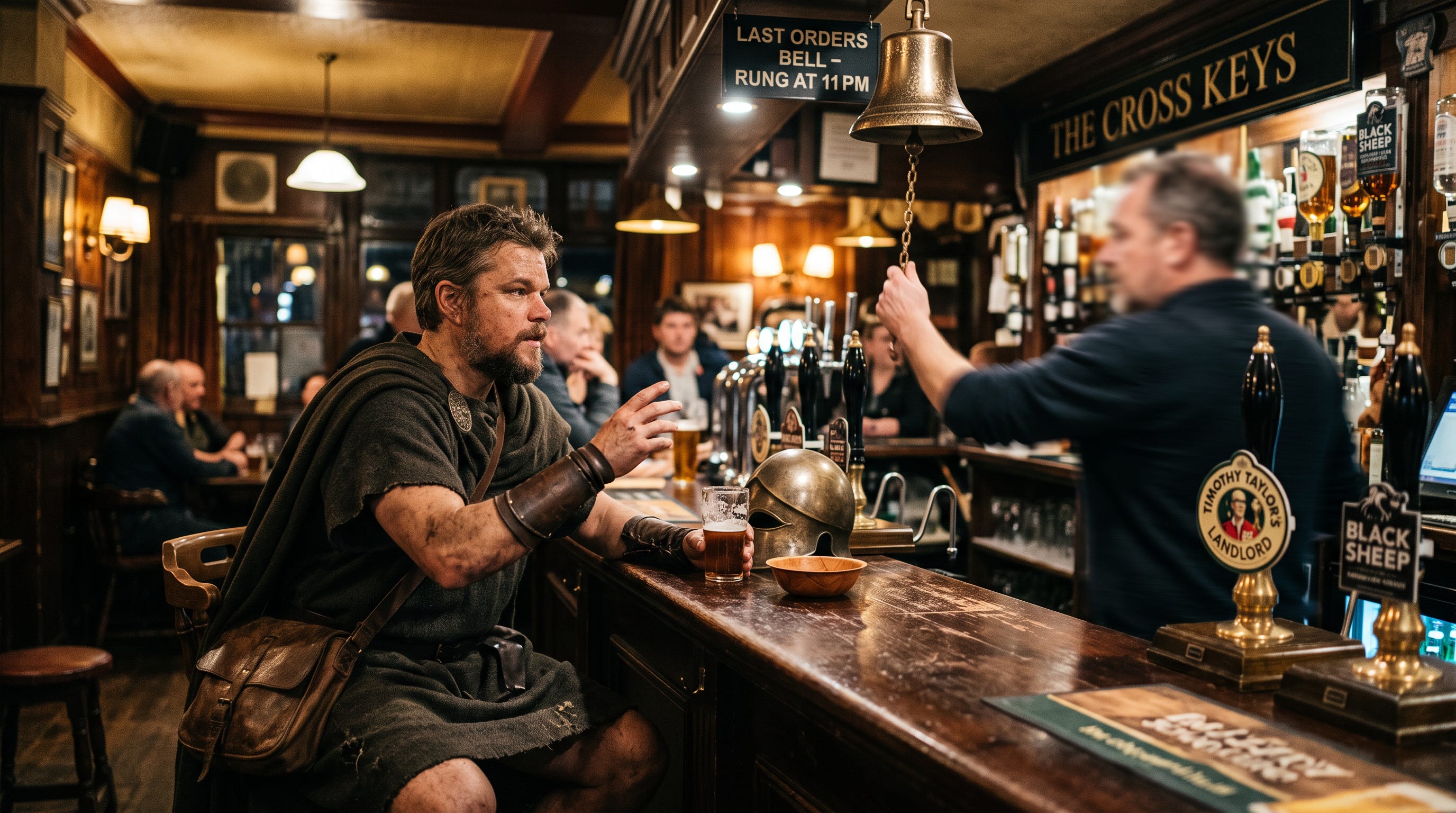
For readers unfamiliar with the Odyssey, the climax of the epic tale of one general’s return from Troy is a competition to see if anyone can string his bronze bow and shoot it through 12 axe heads. Many suitors, keen to finally bed his wife, attempt the challenge, only to pant and grimace as the bow refuses to yield. This goes on for some time, until Odysseus, disguised as an old man, does it with ease before proceeding to shoot through the heads and begin dispatching the suitors who have eaten through his estate and dishonoured his servants in his absence.
For anyone who saw the film, none of this will be unfamiliar, for this is what the film depicted, complete with a satisfactory twang note when he tests the bow. While this directorial decision is praiseworthy, to what extent did Christopher Nolan, the renowned British director of Batman, Inception, Dunkirk, and Oppenheimer, sufficiently manage to capture the magnitude of the Odyssey - in other words, did he manage to string the bow himself?
Having listened to the poem over the summer and only watched the film in late August (hence the lateness of this review), I will, in quintessential actual Odyssey fashion, tell you exactly what is about to happen, before embellishing my review with succulent details that make it still worth reading despite its known outcome.
In short, while Nolan succeeded in warming and greasing the bow, he failed to string it for four reasons. Firstly, and most chiefly, because he didn’t keep to the text; secondly, because he allowed wokery to hinder his efforts; thirdly, because he excluded the gods; and fourthly, and flowing from all this, because it was too short. Best of all, for anyone who makes it to the end, I’m going to tell you exactly what should have happened.
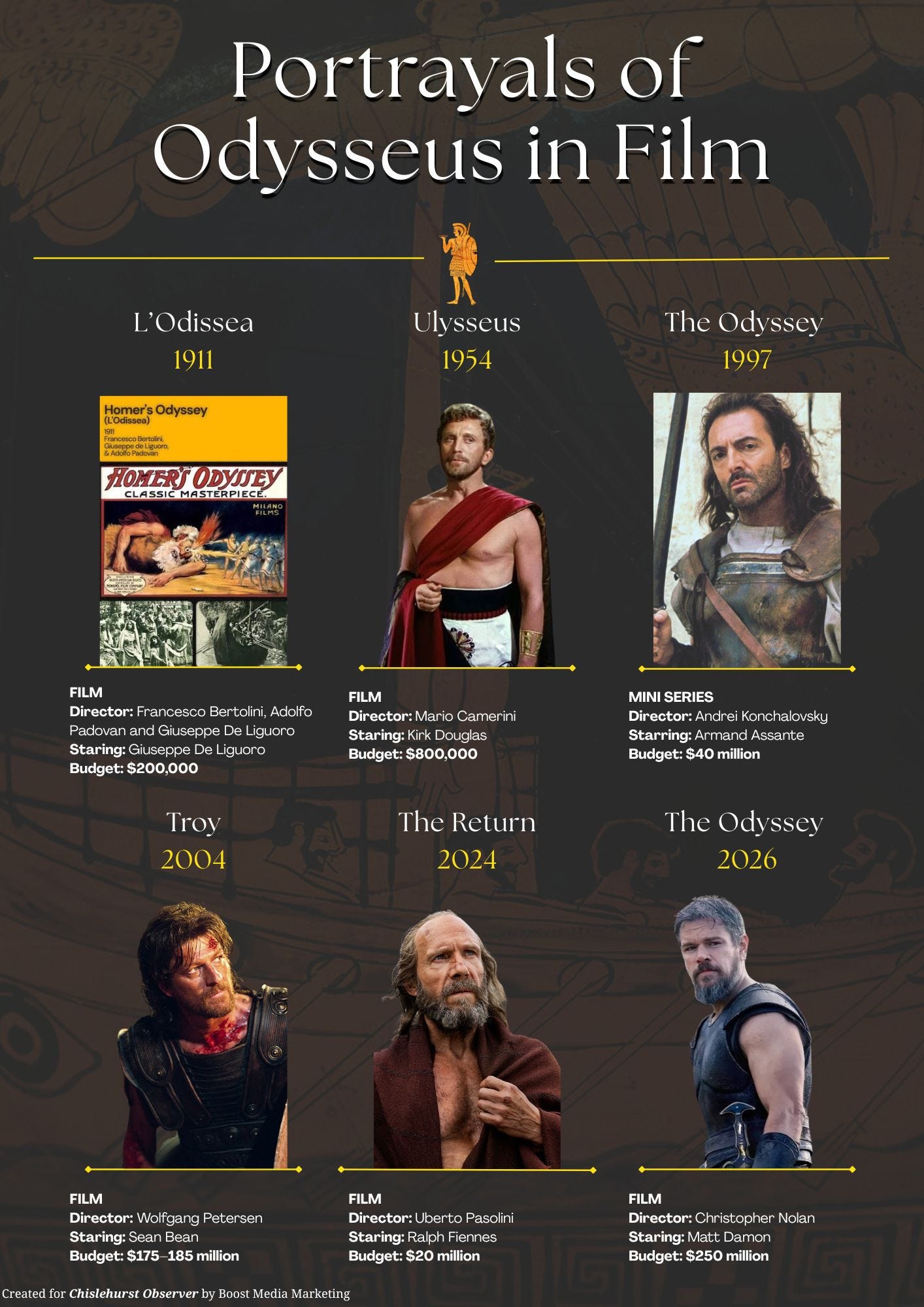
Don’t get me wrong, a mere two years after director Uberto Pasolini attempted it in The Return and 19 years after Andrei Konchalovsky attempted his mini-series, Nolan’s attempt was a valiant effort and well worth the £7.50 we paid to watch it at our local Vue. The real locations spanning seven European countries, the reimagining of the Trojan horse, the superb acting of main roles minus a few, the pounding score, the CGI monsters and the epic sacking of Troy scene made everything feel very real. Yet realism, when it comes to Greek mythology, is no substitute for accuracy, and as such, Nolan’s unwillingness to tell the story as Homer does drastically limited the power of the story.
In some senses, I think the film never got into its stride. So many of the internal organs of the original text, the characters, scenes and lengthy speeches, were removed, combined or truncated that it lost its soul, or, to quote my mum, “It was long and boring. When someone died I didn’t care.”
This was no band of brothers. It felt like extras with oars.
When faced with the challenge of retelling a story everyone already knows, a director has two choices. Either they drastically reinterpret it to a place of newness, or they keep the core elements but play out their themes by developing smaller characters.
Nolan, in my opinion, chose the first path. His reinterpretation of the Odysseus as a guilt-ridden general, whose story was slowly etched out by Calypso on a Sandals holiday for retirees, while his feminist wife lamented her glass ceiling with her pubescent child, who never quite comes of age, was simply not how the text goes.
In doing so Nolan chose to skip over a whole raft of information that the poem spells out at considerable length, not least the fact that he leaves Calypso’s Island not on a raft, but on a full-blown boat he made from scratch over four days (one of many epic montages the film would have benefited from). In fact, in the original, the tale is told not by Odysseus to Calypso, but by Odysseus in an epic speech over dinner in the house of King Alcinous after a hilarious sports day on the beach (none of which the film covers). In the actual poem the atheistic Cyclops speaks a lot; the lotus eaters are their own chapter, the Laestrygonians are not men in steel armour in a wood and his visit to the underworld, perhaps one of the most interesting chapters in the poem, involves moving conversations with many fascinating known and lesser known Greek figures including Achilles, Hercules, Ajax, and perhaps most movingly of all his Mother.
In the poem the Sirens actually make enticing music and don’t require binoculars to see them. Most significantly of all, Telemachus, his son, fights next to his father at the end, along with the swineherd, who is not blind, in what is really a fully clad final battle and not the brawl that Nolan made it out to be. All the suitors are killed without mercy, much to the relief of the reader, along with 12 unfaithful female servants who are hanged out back, after they have mopped up the blood. The house is fumigated with sulphur and put back in order, and Odysseus orders a voluminous party to cover over the fact that all the nobility of his island now lie in a heap out back. The reintroduction to Penelope, while not immediate, is complete and satisfying and without a spear awkwardly hanging down from Odysseus’ ribs.
It’s Nolan’s film; he can do what he wants, I get that, but if you want to string Odysseus’ bow, you must do it Homer’s way. Not only did he not do this, but he made silly woke decisions that considerably hampered his efforts.
The film starts with a bard hitting a stick against a table and muttering a combination of words that relate to Troy. He certainly gets our attention, but had he been an authentic bard, in the line of Homer, I’d assume he’d have played music, sung rather than spoken, or at the very least formed complete sentences. The fact that he is played by actor who is black doesn’t and shouldn’t matter, it is entirely plausible in the ancient world that such bards existed, but having just finished the poem, I couldn’t help but feel this was a second rate bard not worth his salt and in danger of a stool considering the insatiable audience. What ever real world emotions this conjured in me were eclipsed moments later when you are whisked off to a beach to meet a character called Sinon - a male warrior played by the female actor Elliot Page.
Now, to be clear, Sinon, who is said to have deceived the Trojans into accepting the horse, never appears in the Odyssey; he comes instead from the Roman text of The Aeneid. So Nolan is already bending things by having the character in his film, let alone casting the female Page in the role. While rumours online about Page being cast as Achilles were proved laughably false, Nolan does give the character a significant speaking part, in life and in death, for she dominates the underworld scene later too. He also casts Sinon’s younger self as a biological boy, adding to the confusion. If this was simply woke sprinkles, it could be tolerated, but I think decisions of this nature are woke sabotage.
The irony here is again, if he had allowed the text to defend itself, there is enough in there to capture the nuances of mankind without having to inject it with tokenism, feminism or transgenderism. You want nuance, it’s already there. In fact I’d argue the text provides enough water between a feminist reading (we’ll call this Scylla) and a misogynistic one (we’ll call this Charybdis) that Nolan could have passed through relatively unscathed. Instead he haemorrhaged my respect, like oarsmen, in both directions.1
All the while he avoided the weird and far from wonderful world of Greek gods. That would be fine were they not utterly integral to the original poem. It’s not the first time either. Nolan left the very real interventions of the Christian God out of Dunkirk to its detriment, and now he gutted the Odyssey of all but one. As a Christian writer, I can appreciate the refining of the whole Greek pantheon into a more monotheistic Judeo-Christian equivalent of Zeus-like laws that made it more relatable. Given the time constraints this was a clever catch-all tool, yet this goes against my core point of textual accuracy. Odysseus was no less bothered by the sacking of Troy than he is by the two sexual affairs he has on his return (with Calypso first and Circe the witch – the latter he is instructed to sleep with by Hermes). Men satisfying their passion with gods and vice versa, this is the icky world of Greek paganism. If Christianity, or a grace filled Judaism, was to be included in the film it should have been played out by a minor character (a bit like Athelstan in the series Vikings2) rather than by glossing over the chaos of Greek mythology. In doing so Nolan missed a glaringly fun opportunity.
If he doesn’t do theology he could have poured scorn on them by casting Hollywood geriatrics in cameo roles: Clint Eastwood as a male beggar, Kevin Costner as Poseidon, Arnold Schwarzenegger as Zeus, Eddie Murphy as Hermes. Admittedly this is not Nolan’s go-to cast, and it would have taken things dramatically off course, but if any film could handle some re-routing the Odyssey can, and if any director could have found a way – Nolan could. What is certain is that removing them entirely was a bad decision. Like removing tanks from a WWII war film, you simply cannot explain the way people act without them. As others have pointed out, “Zendaya playing Zendaya” kept no one happy.
The ultimate tragedy in all this, and considering the remarkable non-linear way the story is told, is that there was so much in the original version for Nolan to dig his teeth into had he been given more time.3 For all the exceptional acting in the film, I wanted to see more Steve McQueen-esque long-form, single-shot scenes, mini-Odysseys by which each of the characters – particularly Odysseus’s crew and King Alcinous – are explored more deeply. He could have even developed the bard’s character, mentioned earlier, being after all, one of the few characters who walks out of the final bloodbath alive.
Given everything that I’ve said, the Odyssey should have been at the very least a trilogy, or even a mini-series. As outlandish as this statement may sound, considering it cost £250 million to make, increasing its length would actually be a perfect way to build out the characters, monsters, themes and revenue all at once. Had Nolan done this, we may have had the opportunity to let Cyclops speak, meet Kings Laertes, Alcinous and Aeolus, or allowed Telemachus to grow an actual beard!
Had Nolan been given this opportunity the skill would not be in the changing but in the pacing. For example, Odysseus could see his palace at the end of film one, only to be blown off by the “bag of wind” into the islands of the huge cannibals, the Laestrygonians, ready for film two. The second film could have dealt with the monsters and Troy from multiple angles using the underworld scene as a pivot. He could have even stunned the world by bringing Brad Pitt back as Achilles (just a thought). By the final film, which should have begun with Odysseus’ foot planting on one of Ithaca’s jagged beaches, the marketing budget should have been scrapped, for the whole world would be pining for Odysseus and Penelope’s reunion. What’s more, Nolan, like Jackson in the final Lord of the Rings film, could have taken his sweet time in a final battle, cleanup and reunion. It could have been the stuff of dreams, a scratch to end all itches, and if people didn’t like it Nolan could simply say “it’s what the text says”.
Alas this was not the route he chose when attempting to cross the “broad back of the sea” meaning that somewhere out there Odysseus’ wooden bow remains unstrung.
The question is who will attempt to string it next?
Take for example the word kynōpis (κυνῶπις) in the original. Meaning quite literally “dog-face” but normally translated as “b***h”, it is used multiple times in the book, most starkly, of the dead King Agamemnon in relation to Queen Clytemnestra who murdered him on his return from Troy (which the film covers well in my opinion). It is also used of Melantho, the treacherous maidservant who sides with the suitors (which the film also coveres). Do either of these characters deserve such a label? Perhaps, perhaps not. Let the reader/viewer make up their own mind according to the facts. With the whole poem under the gaze of "noble" Penelope and guided along by the fair and benevolent Athena (even if she does like disguising as men), no one can call the text misogynistic at core. Meanwhile Nolan glosses over the fact that while noble Penelope is remaining chaste, Odysseus engages in no less than two sexual affairs on his way back, both with spell-casting witches, which in itself raises interesting questions over power and consent. The latter fling with Circe (played well by Samantha Morton), he engages in under the instruction of Hermes, who, like my review, tells him exactly what will happen and what he should do, before it does.
Regrettably the same character, despite a noble start, ends up becoming a Viking and joining on missions to duff up Anglo-Saxons, including fellow monks. This is before being captured and re-becoming a deeply conflicted monk (for obvious reasons).
As others have pointed out, the non-linear way that the Odyssey is written really plays into Nolan’s style. It begins with Telemachus at home seeking to find news of his dad, before many chapters later introducing you to an Odysseus bobbing up and down on the high seas. Once located, you still have to endure two or three more chapters of swimming, sleeping, bathing, feasting, and begrudgingly competing in sports day before Odysseus finally tells his story in full, from the horse's mouth so to speak. Most people know the main story, but I think the real missed opportunity was connecting the in-betweens.